
SeeTreat to Launch ART.1 to Support Adaptive Radiotherapy at ESTRO 2025

SeeTreat will debut its first clinical product, ART.1, at Booth 820 during ESTRO 2025 in Vienna. ART.1 is a software as a medical device that delivers objective, evidence-based decision support for adaptive treatment re-planning in patients undergoing radiotherapy.
ART.1 automatically calculates delivered dose and propagates daily contours based on each patient's volumetric imaging, while displaying and reporting key clinical metrics. Running silently in the background, ART.1 prioritizes only the patient cases needing attention—allowing clinical teams to focus their time where it matters most. The software adds efficient, adaptive-quality treatment capabilities on any standard linear accelerator—without hardware upgrades or workflow disruption.
“Adaptive radiotherapy has traditionally been complex, costly, and limited to well-resourced centers. ”
“We designed ART.1 to perform background analysis of every fraction, prioritizing major deviation, and give the clinical team a second set of eyes—without adding to the workload, resources or time.”
— Trang Nguyen, CEO and founder of SeeTreat.
What Makes ART.1 Different: Saving Days, Not Hours
ART.1 integrates seamlessly with existing linear accelerators and treatment planning systems, and automates the most resource-intensive steps in the adaptive workflow:
- Analyzes every structure for every fraction using synthetic CTs, daily dose calculation, and deformable contour propagation
- Sends alerts based on protocol thresholds for dosimetric and volumetric changes to treatment volumes and organs at risk
- Prioritizes patients for review—reducing unnecessary checks and freeing up staff
- Minimizes manual work by automating and prioritizing your adaptive workload
With detection, analysis, and alerts built into a single workflow, ART.1 reduces time to inform a decision from days to minutes—empowering the clinical team to act faster, with greater confidence.
Purpose-Built for Adaptive Radiotherapy
ART.1 was built from the ground up to support daily adaptive evaluation—without new hardware, major IT demands, or added staffing. Its software-only model fits into existing infrastructure, making it ideal for regional and community cancer centers where resources are tight but precision matters.
“We designed ART.1 to perform background analysis of every fraction, prioritizing major deviation, and give the clinical team a second set of eyes—without adding to the radiotherapy workload, resources or time.”
— Trang Nguyen, CEO and founder of SeeTreat.
SeeTreat at ESTRO 2025
Attendees can see ART.1 in action and meet the team behind it at Booth 820. To schedule a 1:1 demonstration, visit: https://tinyurl.com/3yy6fa34
ART.1 is available for research use. UKCA and CE mark pending.
About SeeTreat
SeeTreat is an Australian medical technology company focused on making adaptive radiotherapy safer, faster, and more accessible. Founded in 2023 by Dr. Trang Nguyen and Prof. Paul Keall, SeeTreat enables equitable access to precision cancer treatment, potentially reducing the burden of cancer worldwide. The company builds intelligent software that automates the most difficult parts of the adaptive workflow— helping more clinics deliver adaptive-quality care, every day.
Related news
 Dr Trang Nguyen29 September 2026
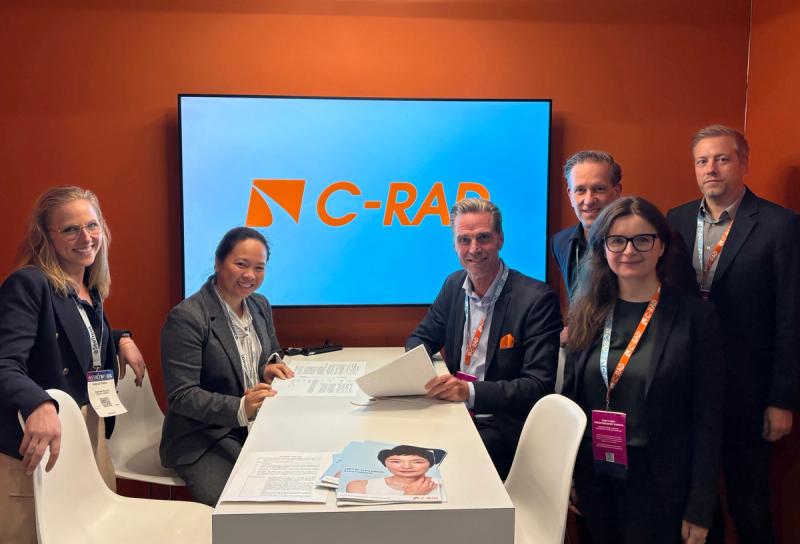
C-RAD and SeeTreat partner to co-develop personalised radiotherapy for every patient in every clinic
C-RAD and SeeTreat partner to co-develop personalised radiotherapy for every patient in every clinic UPPSALA, Sweden/SYDNEY, Australia – September 29, 2026 – C-RAD (publ) the global leader in surface-guided radiation therapy (SGRT), and SeeTreat Pty Ltd, a pioneer in the adaptive decision support radiotherapy (ART) software, today confirm a partnership to co-develop more connected, intelligent, and patient-centric radiotherapy workflows.
Read more
 Dr Sean Pollock17 September 2026
ABC Radio National interview - Changing Australia: Paul Keall and innovating with radiotherapy
SeeTreat co-founder Professor Paul Keall speaks with Sally Sara on innovating with radiotherapy. Prof Keall writes of this interview: "It was an honour to be invited to contribute to the ABC's Changing Australia series hosted by Sally Sara. On the question of how to bring innovations in radiotherapy to large numbers of patients I am proud that we at SeeTreat are doing just that: developing accessible technology to ensure that the radiation treatment is personalised to the patient throughout their course of therapy."
Read more
 Antonia Dalton19 May 2026
SeeTreat's ART.1-US Software is FDA Cleared for clinical use in the USA
SYDNEY, May 18, 2026 /PRNewswire/ -- SeeTreat's ART.1-US software delivering automated adaptive decision support for every patient at every treatment is cleared for use in the USA. From today, US clinics with Varian or Elekta CT linear accelerators, will be able to access daily evaluations of radiotherapy dose to patients' changing anatomy. With ART.1-US, clinical teams can now decide the right time for a new radiotherapy plan in 95+ seconds[1], and download supporting clinical documentation.
Read more